


There are several ways to assemble good audio systems: based on technical logic, budget, or luck. And then there are those components that seem ready to be paired up if the opportunity arises.
That’s exactly what happened with this Franco-British pair. I received a call from Delfin Yanez: “You have to hear the new Monitor Audio Bronze 50s!” “OK,” I agreed, “But you’ll also need to send a matching amplifier, because the MA50s require an amplifier with more power and control than their size suggests, according to my colleague Paul Miller at Hi-Fi News.” And so he did.
So it was a happy coincidence that I paired in this dual review: the Advance Paris A8 APEX 30th Edition (€1990) hybrid integrated amplifier, commemorating the brand’s 30th anniversary, and the Monitor Audio Bronze 50 7G (€600/pair) stand-mounted speakers, a brand with over 50 years of history that has, forgive the redundancy, 'branded' my career as a critic since the days of Mo Iqbal, the visionary who bet on metal cones for speakers against all odds.
A meeting where I’ve brought together a Frenchman, who wears a silk scarf infused with the scent of vacuum tubes, and a seductive Englishwoman in high heels, whose rhythm and dramatic stage presence far exceed her petite stature, much like Meloni, the Italian prime minister.
Two Franco-British personalities that promise to be intriguing even before the meeting starts. Essentially, it’s a gathering of two products from different cultures. With this duo in your living room, you won’t just get excellent hi-fi sound; you’ll experience presence, poise, charm, and… a bit of culture shock to boot.
Franco-British Duo
The A8 APEX is a retro-style hybrid amplifier with white VU meters illuminated by ECC81 tubes that peek playfully out of the first-floor-right window, yet it offers all the modern conveniences. The Bronze 50 7G are compact British speakers, now in their 7th generation, with a sound bigger than their modest stature suggests. The key is to get the whole by balancing individual traits. First, you must understand the players to build a real partnership—not just a marriage of convenience.
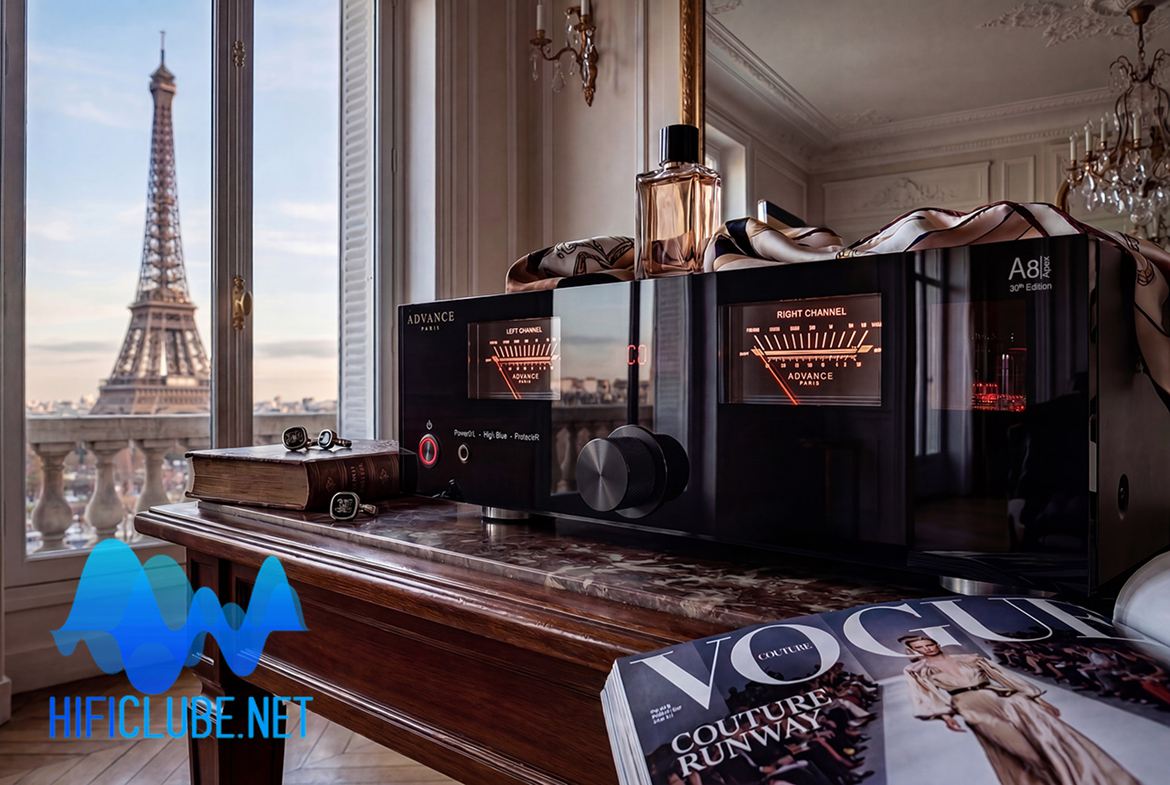
Advance A80 Apex: a French amplifier that wears a silk scarf infused with the scent of vacuum tubes
Advance Paris A8 APEX 30th Edition
The A8 APEX is the entry-level model in Advance Paris’s new commemorative APEX line. But note: the label “entry-level model” does not do justice to the level of engineering, much less the visual ambition of the unit. There was no temptation here to strip it of the brand’s personality just to sell it cheaper.
Advance’s key design elements are all present: tubes in the preamp stage, transistors in the power stage, and that French flair for visual luxury. In the 30th-anniversary edition, the A8 Apex is wrapped in black, with high-contrast white VU meters replacing the brand’s usual blue. It’s like wearing a black tuxedo and a white silk bow tie, ready to attend Advance's birthday party.
The rated power is 2 x 76W into 8 ohms and 2 x 110W into 4 ohms, with ECC81 / 12AT7 tubes in the preamp section and a Class A/B transistor power stage, powered by a 240VA toroidal transformer. It also features a switchable high-bias mode, which increases the bias to extend Class A operation.
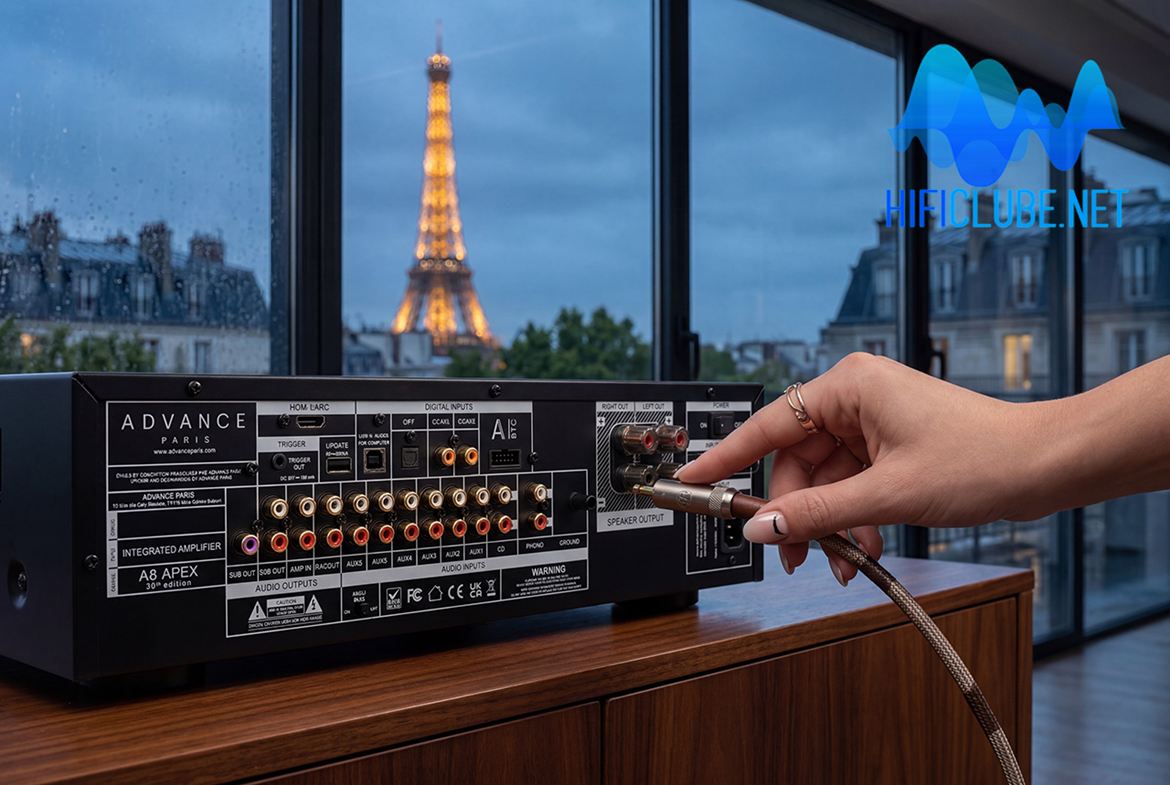
The A8 Apex preserved the brand’s belief that ‘romance’ and ‘convenience’ can coexist.
But what makes the A8 Apex so special is not its hybrid topology—which isn’t revolutionary, since it’s already part of its DNA—but rather that it has preserved the brand’s belief that ‘romance’ and ‘convenience’ can coexist. Therefore, despite its classic appearance, it is a modern integrated amplifier that offers:
- Eight analogue RCA inputs, including MM phono
- Two coaxial inputs, one optical, one USB for computer audio
- HDMI eARC with CEC, allowing you to turn on the amplifier when you turn on the TV and control the volume from the TV remote
- Pre-out, amp-in, subwoofer output, record out, and trigger out
- Tone, balance, and loudness controls
- A 6.3 mm front headphone output
- Optional Bluetooth via the A-BTC module
Almost all functions can be operated remotely or by turning and pressing the volume knob.
Even the 30-second tube warm-up, shown as a countdown on the screen, creates a sense of anticipation in the listening experience, suggesting that good things are worth waiting for.
On the digital side, the A8 APEX features an ESS Sabre ES9018, supported by ES9312 drivers, compatible with PCM up to 24/192 via coaxial and optical inputs and PCM 24/192 plus DSD64/128 via asynchronous USB with XMOS.
Nothing excessive. Just a very capable DAC that isn’t there just to check a box on the spec sheet. As a source, I used a Bluesound Node Icon streamer, connected via RCA cables (analogue signal), and when I bypassed the Node Icon’s DAC with a USB cable (digital signal converted in the A8), I noticed more texture, body, and spatiality. For what it’s worth, that’s a good sign(al).
My only regret is that the A8 APEX doesn’t have a more advanced headphone section, like the one on the A12, which lets you adjust the gain and output impedance. With many headphones, a lower output impedance generally provides better control and less tonal drift (read the review here). But Advance had to cut corners somewhere on an entry-level model. And it didn’t cut corners on the essentials; it cut corners on trivial features.
For a handful of euros
For example, the display lighting can be dimmed but not turned off, which can be inconvenient when using the A8 as a TV sound amplifier via HDMI ARC: the two screens are visually incompatible. Furthermore, it lacks XLR inputs and switching between the A and B speaker output terminals. Finally, Bluetooth is optional. Each reader will decide for themselves whether this is trivial or essential.
For a price just under 2,000 euros, I consider the few compromises acceptable, especially since the money was invested where it should be: in the amplification, the DAC, and the French luxury design.
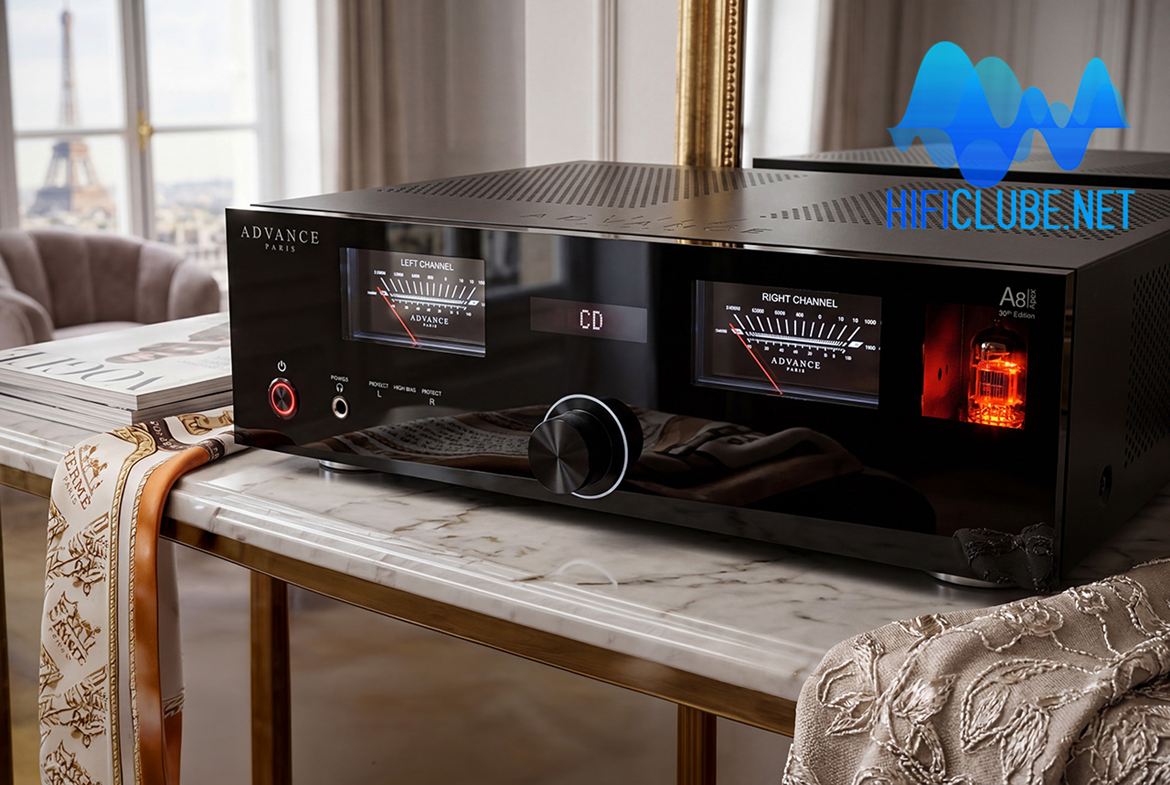
For a price The money was invested where it should be: in the amplification, the DAC, and the French luxury design.
Regarding the sound, the goal here is to evaluate it alongside the British MA 50 7G. However, I’ll give you a brief overall assessment: smooth and warm without sounding dull, good dynamics with lively bass, just the right amount of detail, a slight treble emphasis that diminishes as the valves warm up, and an excellent soundstage with good depth reproduction and well-defined front-to-back planes.
Additionally, the remarkable reproduction of the human voice, especially the male voice, is notable despite a touch of sibilance that becomes less noticeable with each listening session. I believe this is partly due to the MA Bronze 50s: metal tweeters need to be ‘polished’ with time and patience.
Let’s say the A8 provides the silk and the MA50s provide the steel. Between them lies that rare chance of balance—a balance between high fidelity and diplomacy where the most memorable agreements are often made.
The A8 doesn't favour the current forensic pursuit of the perfect SINAD. It belongs to the distinguished school of amplifier design that favours elegance over the flash of the spotlight.
In a world where logic matters more than feelings, not being perfect is no longer a flaw — it’s a virtue.
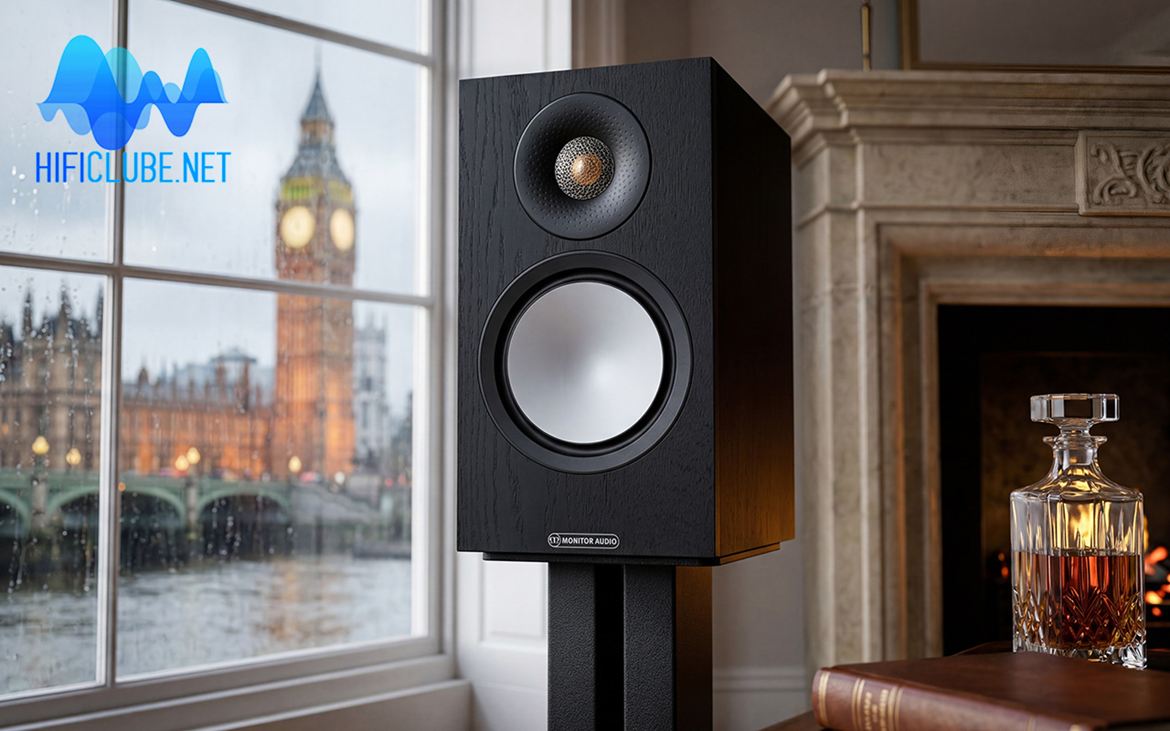
Monitor Audio Bronze 50 7G - Modern classic.
Monitor Audio Bronze 50 7G
The UK's delegate to this summit proved to be compact yet irreverent and unexpectedly combative while maintaining the charm of the aristocracy. Like any woman in her fifties, she has undergone some significant improvements to stay beautiful and in shape:
In this seventh generation, the Bronze 50 has been clearly reimagined. It now features a 6-inch C-CAM woofer/midrange driver and a 25mm C-CAM Gold Dome tweeter, integrated into Monitor Audio’s UD waveguide II. The cabinet features an 18 mm plywood front baffle, coupled to an MDF frame; the rear panel houses a HiVe II bass-reflex port and dual terminals for bi-wiring.
The official sensitivity is 86 dB, the nominal impedance is 8 ohms (minimum 4.0 ohms at 200 Hz), and the stated frequency response is 41 Hz to 30 kHz. The crossover frequency has been raised from 2500 Hz to 3000 Hz.
To put it simply:
The seventh generation introduces a larger bass/midrange driver than the Bronze 50 6G, a revised magnetic system, a larger voice coil, a stiffer tweeter, a redesigned crossover, and a waveguide designed to improve time alignment and directivity.
The Bronze 50 G7 delivers impressive bass!

The hexagonal filigree of the tweeter's grille is as beautiful as a bride's veil!
The hexagonal filigree of the tweeter's grille is as beautiful as a bride's veil and blends well into the hexagonal pattern of the concave waveguide, with minimal obstruction. The result is a compact speaker that sounds less compressed, less directional, and appears less “budget-friendly” than its predecessors.
The Bronze 50 7G delivers impressive bass! We could simply leave it at that. But it’s worth noting that reaching down to 40Hz (-6dB/200Hz), even with a little help from the reflex port, is remarkable for a compact speaker. Yet that’s only part of the story. The bass isn’t merely deep; it’s articulated, well-defined, and rhythmic.
Note: If you place them on a shelf or very close to the wall, you may need to fit the port foam bungs to prevent excessive bass. However, simply moving them 20 cm away will avoid the need to do this, which would be a shame, as the port is very well tuned.
The MA50 is a fast speaker, and its bass shapes the midrange’s body, making male voices and piano sound incredibly real, present, and clear, thanks to the well-controlled resonance of the reflex tube around 1kHz. Yes, the treble has a slight “peak” that can accentuate sibilance in some recordings, but as we’ve seen, it fades over time.
Tonally, this is the best MA stand mount monitor ever.
Cooperation agreement disclosure
I set up the Advance A8 APEX and the MA Bronze 50 7G in a separate room and let Roon’s algorithm run free on the Icon Node.

First, I listened to Jennifer Warnes’ “Way Down Deep” from the album “The Hunter”. The algorithm knows what I like.
As the track’s title suggests, the sound seems to spring from the floor of the room, as if emanating from the very core of the system, creating an atmosphere of tension and desire, underpinned by an almost tribal rhythmic foundation, with Lenny Castro and Paulinho da Costa on percussion: congas, dumbek, shakers and rattles, along with other small instruments made of skin and seeds, which helps explain that sensation of an organic, textured groove, full of air and substance. This track tests the system’s ability to reproduce rhythmic layers, impact, texture and detail.
Warnes’ voice sounds deep and rooted in the earth, with a touch of ‘huskiness’, which is a noble form of hoarseness. The percussion is the body; her voice is the soul — husky, deep and dangerously seductive.
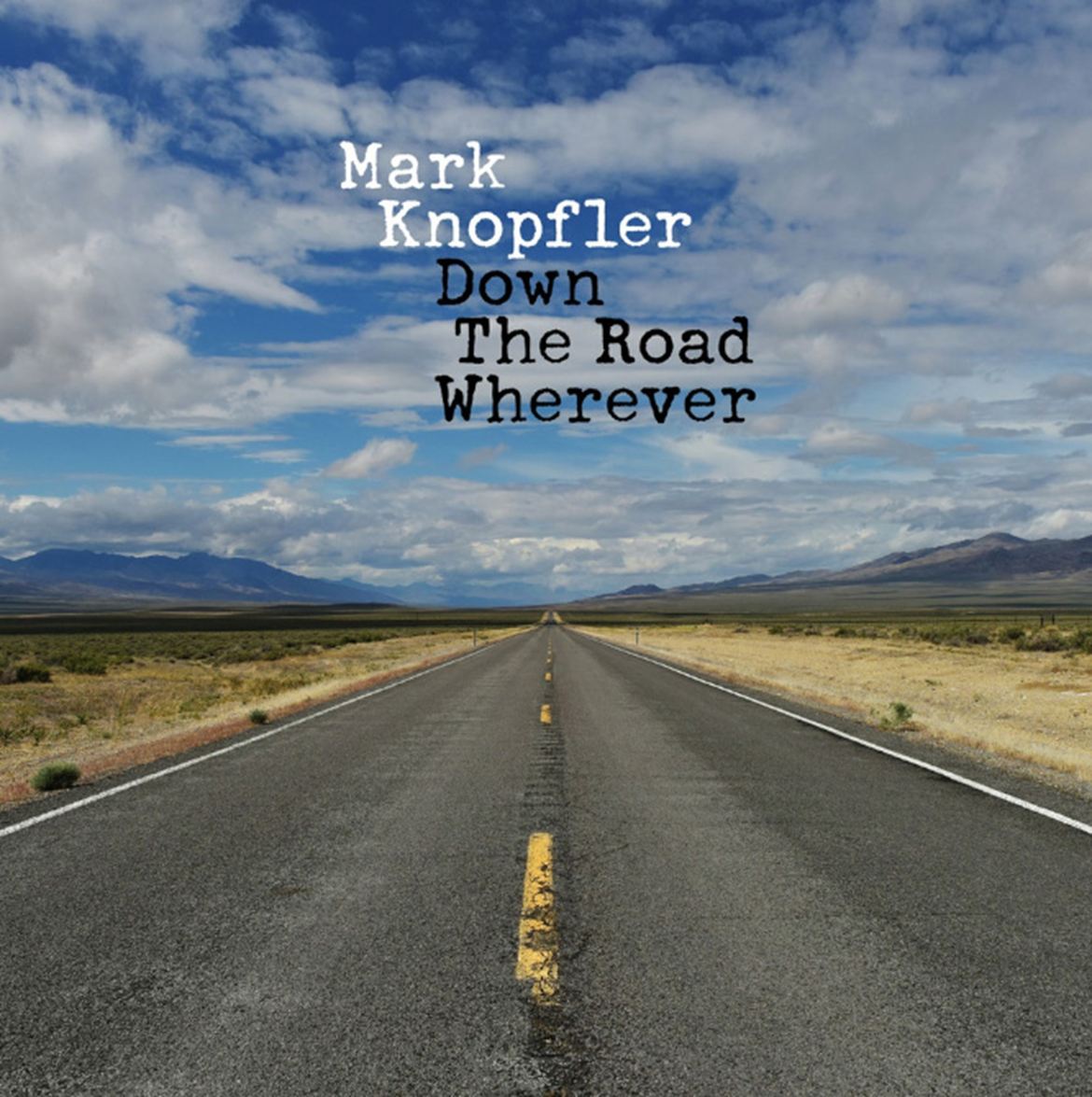
Next came “Slow Learner”, from Mark Knopfler’s album “Down The Road Wherever”, in which he swaps the guitar for the piano, taking on the role of a crooner with the deep weight of his voice, rooted in his chest. The voice has a woody flavour, resonating softly in a placid, whispered intimacy, much like the unexpected trumpet solo. On the MA50s, Knopfler’s voice sounds big, not in an operatic sense but in a narrative one, like someone telling us a story without haste.
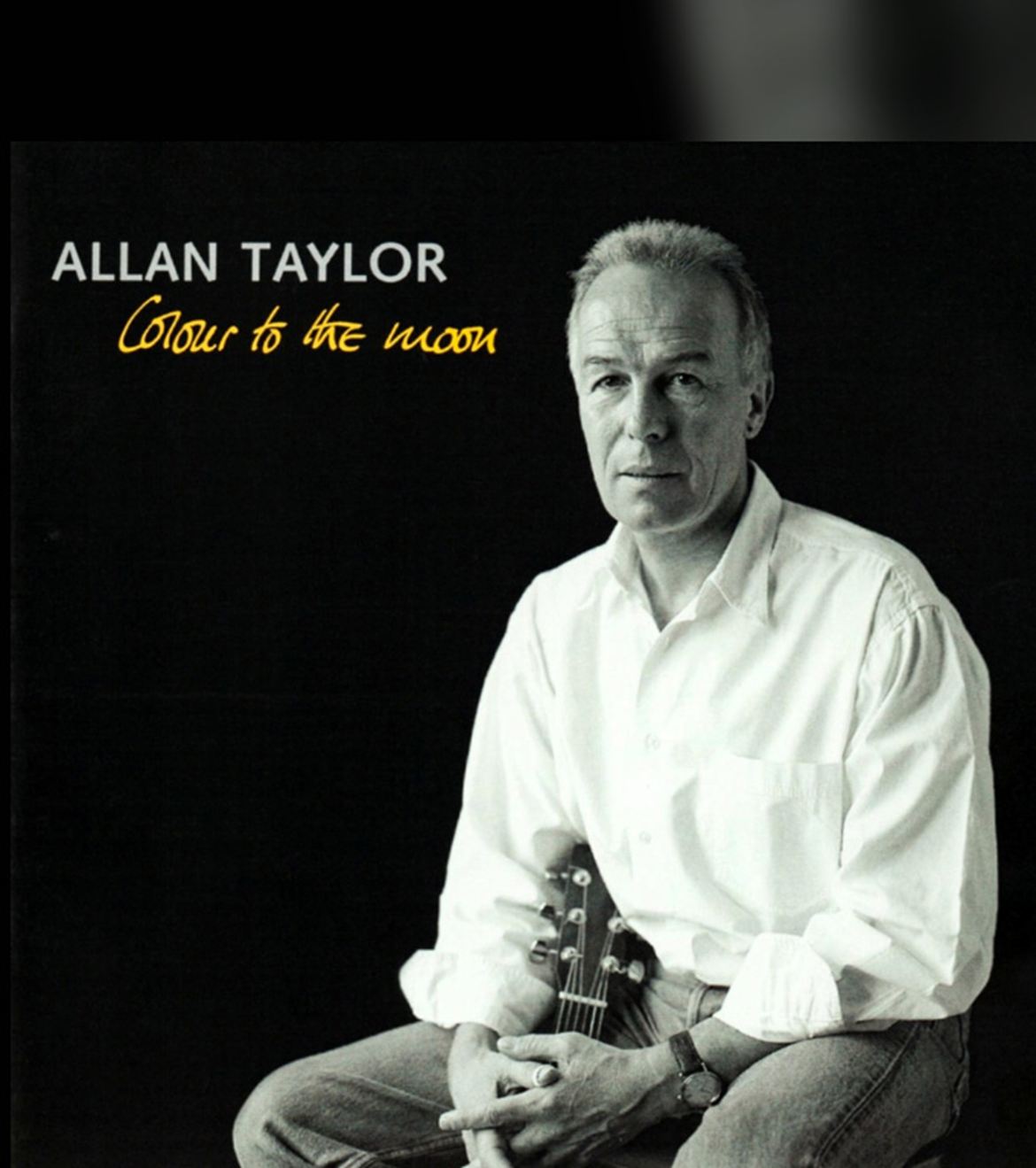
I’m now listening to “Colour to The Moon”, from the album of the same name by Allan Taylor, who also tells us a story with a deep, serene, almost melancholic timbre, disturbed only by a touch of sibilance. The acoustic guitar sounds larger than life, thickly underlined by the bass, which drops to 40 Hz, cut through by Beo Brockhausen’s soprano saxophone and punctuated by the ‘low whistle’. There is space. There is useful silence, fertile in atmospheric clues.
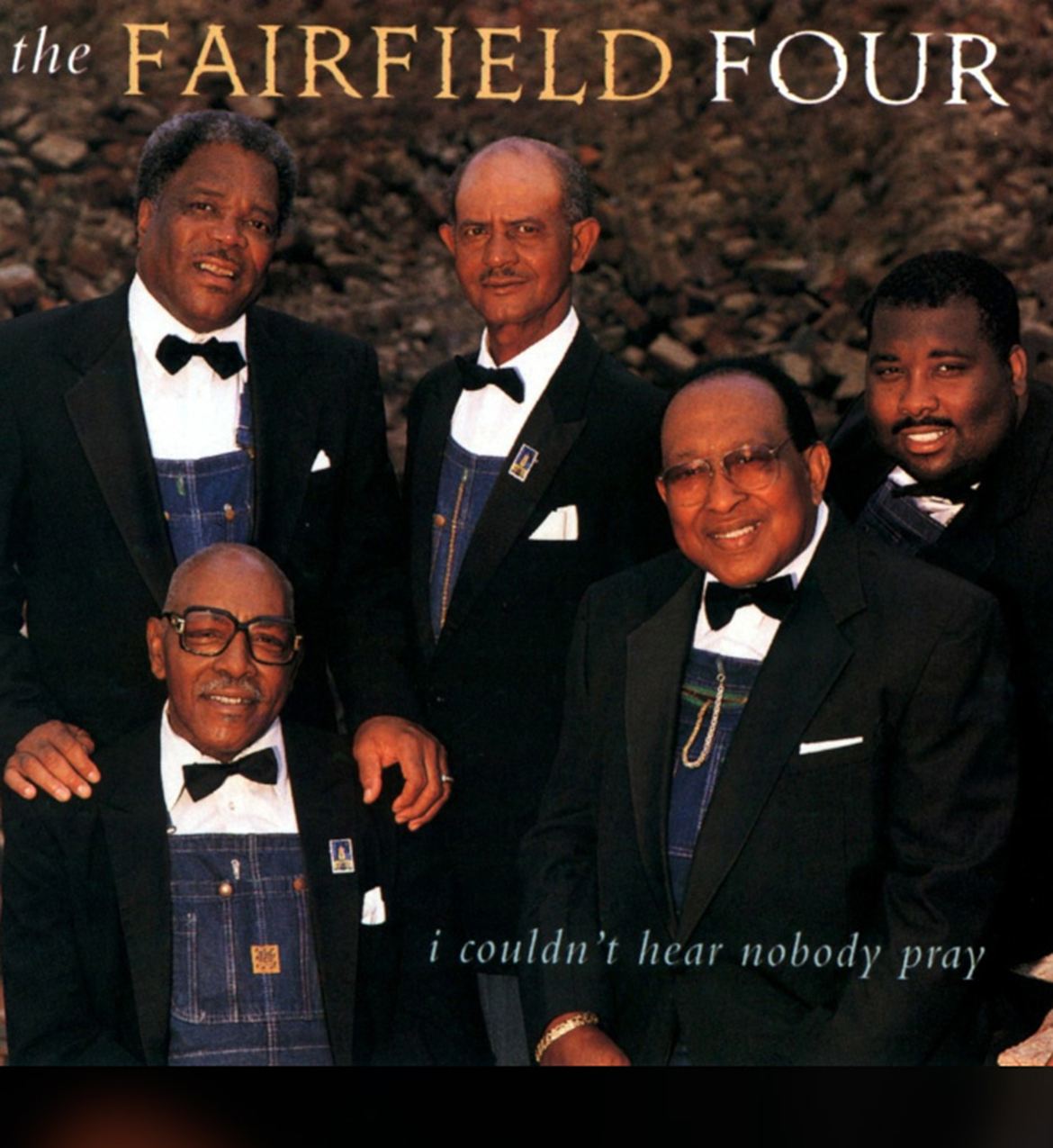
“These Bones”, by The Fairfield Four, from the album “I Couldn’t Hear Nobody Pray”, is more than just gospel, more than just vocal harmonisation. It is a test of the speakers’ ability to reproduce different timbres of the male voice: the lead singers narrate, the tenors establish the clarity of the melodic line; the baritone gives body to the phrasing; and the astonishing bass, Isaac Freeman, is the keystone that supports the entire vocal edifice, with cavernous bass notes that did not faze the MA50s. I’ve heard speakers twice the size fail here.
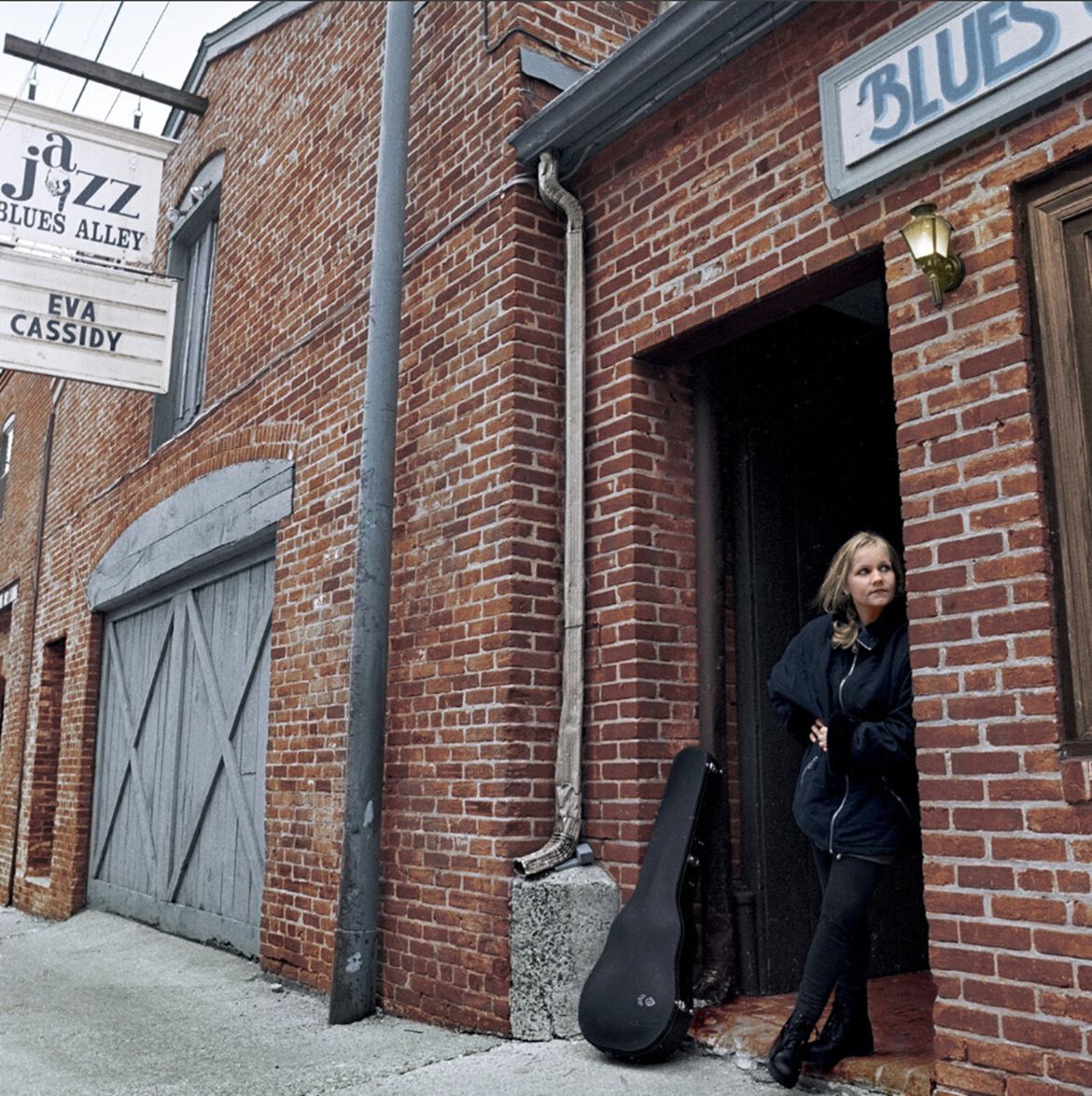
“Nightbird”, from the posthumous album of the same title, sung live at Blues Alley in Washington by Eva Cassidy, whose incredible voice has the ability to sound at once powerful and delicate, clear and sweet, commanding and tender. The live recording suffers from some sibilance in the vocals, and an emphasis on the cymbals, which the MA50s don’t forgive, but all the instruments sound clear and well-defined: from Lenny Williams’ piano to Keith Grimes’ guitar, Chris Biondo’s bass and Raice McLeod’s drums, at a time when Eva seemed to already know she was going to die.
We could stay here all night. But go to Delaudio instead to hear this Franco-British duo. And take your albums with you. Or your playlist. You’ll be surprised.
For more information: DELAUDIO