



Can gaming headphones also appeal to audiophiles who are more interested in music than in gunfire, explosions, and enemies hiding behind doors?
In the past, ‘gaming’ headphones were chosen primarily for their effectiveness in reproducing sound effects, the clarity of voices and the quality of the microphone – essential for coordinating teams via ‘gaming chat’. Music was an afterthought then, not a priority.
With the arrival of planar-magnetic technology in the gaming world, music has become part of the equation. And gaming headsets have suddenly started to appeal even to those who have never held a controller but can tell the difference between full bass and muddy bass.
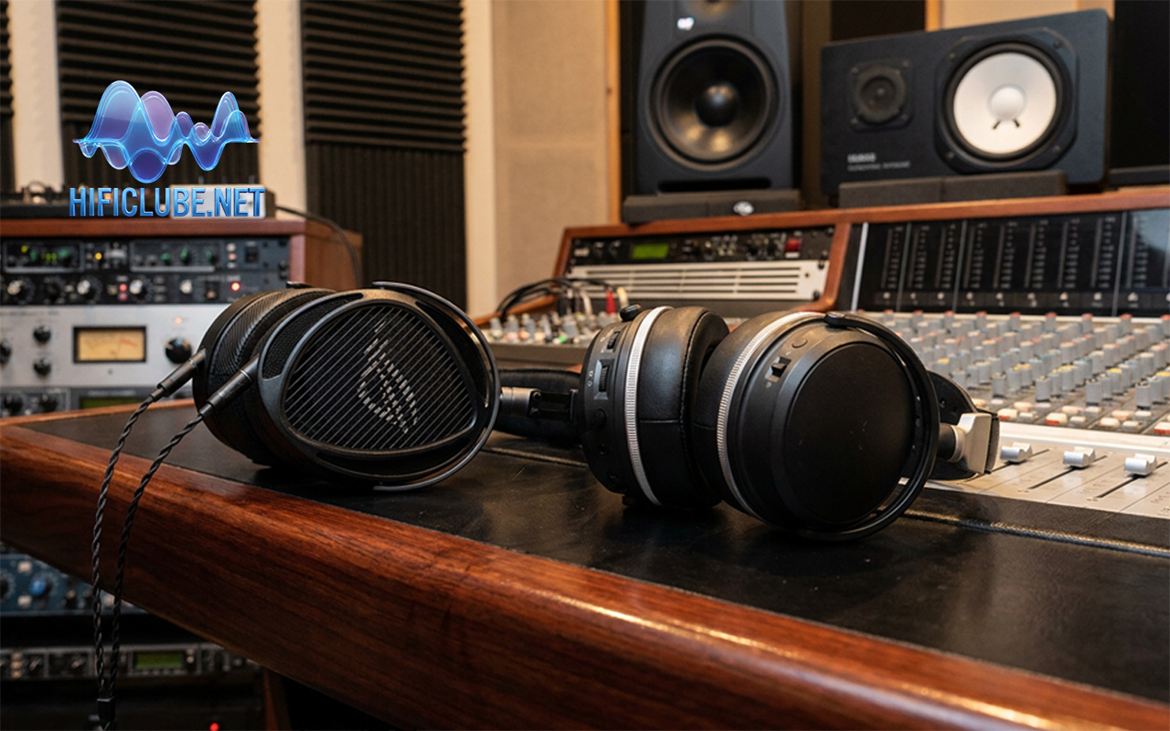
The Audeze Maxwell 2 ANC (450€) and the ASUS ROG Kithara (315€) are both marketed as ‘gaming headsets’. But the only thing they have in common is the transduction technology: both use planar-magnetic drivers, which until recently were almost exclusive to the audiophile world.
And they sound good because there are people who buy them, not for gaming, but simply to listen to music. Not least because, coming from two brands with a track record in audiophilia – Audeze and HIFIMAN, the latter having been involved in the development of the Kithara – they are seen as a more affordable alternative to these brands’ traditional hi-fi headphones.
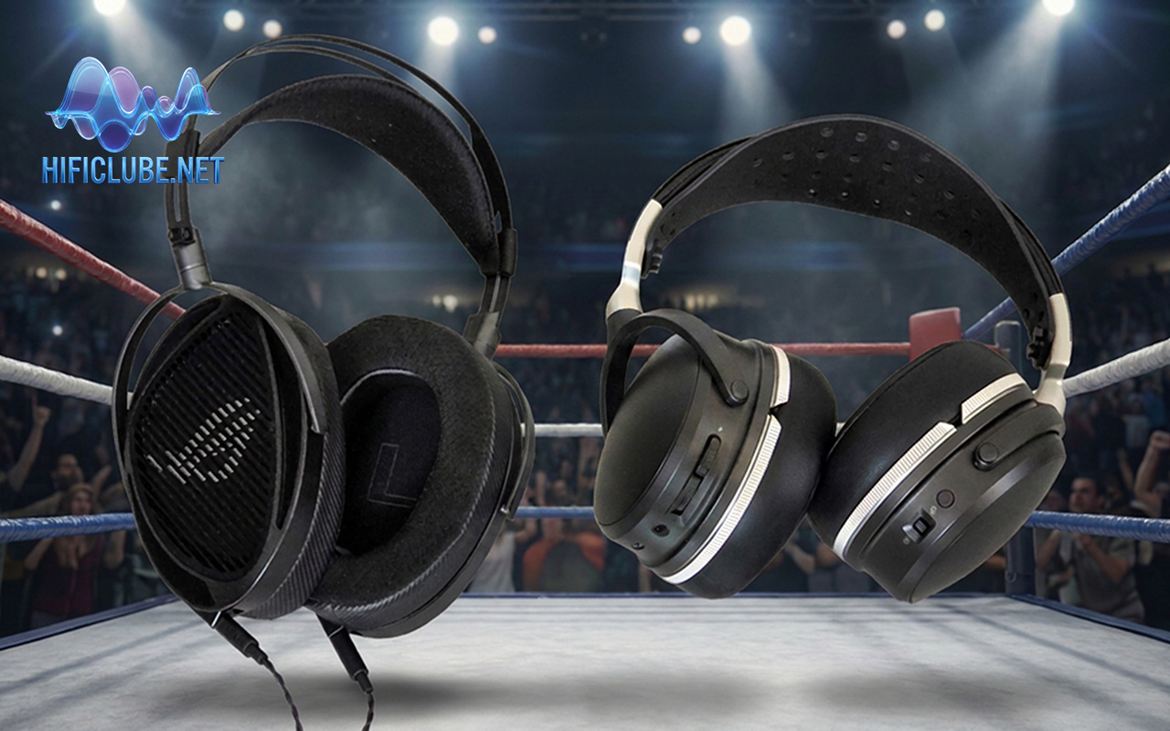
A battle of sounds
However, they are so different from one another that I decided to pit them against each other in a head-to-head comparison, focusing almost exclusively on music.
The ‘gaming’ aspect was left to my grandson, a computer games expert, who found the Maxwells too heavy to wear for hours on end and the Kitharas too open-backed for gaming through the night, competing against players from other continents. Even so, he recognised an important quality in both: they’re very good at pinpointing the ‘enemy’s’ position through sound.
In my case, I swapped the enemies for musicians.
From the battle tank to the stealth fighter
The Maxwell 2 ANC is robust, closed-back, packed with technology, battery-powered and requires no cables – at least in theory. The Kithara looks like the sort of present an audiophile father would buy for his ‘gamer’ son who’s got good marks, even though gaming takes up too much of his study time.
The Maxwell uses 90 mm planar-magnetic drivers, Fazor technology, Fluxor magnets, SLAM acoustic management, Bluetooth 5.3 (you can even answer the phone whilst gaming), a low-latency USB-C dongle, a wired USB-C connection, a 3.5 mm analogue input, over 40 hours of battery life and a detachable hypercardioid microphone. Note: not supplied, but it also has built-in microphones.
This ANC version also offers active noise cancellation and noise reduction via artificial intelligence applied to the microphone. These are different things, and it’s important not to confuse them: ANC reduces the noise reaching our ears, and the AI filter removes ambient noise from our voice when we speak, which I was unable to verify as I did not have the microphone.
It’s also compatible with Dolby Atmos, but we’ll come back to that later.
All in all, the Maxwell weighs around 560 g. And you can really feel it. It feels as though you’re wearing a helmet: sturdy, protective and padded, but also hot — especially in summer. As they’re closed-back, they don’t allow air to circulate as freely as open-back headphones do. On the other hand, they also don’t let sound escape into the environment quite as easily. They isolate you. And, in a ‘gaming’ product, that counts for a lot.
ASUS/HIFIMAN: a different philosophy, the same technology
The ROG Kithara was developed in collaboration with HIFIMAN and uses 100 mm planar-magnetic drivers, a Neo Supernano diaphragm, Stealth Magnet technology and an open-back design. It comes equipped with good-quality cables and multiple adaptors: 3.5 mm, 6.3 mm, 4.4 mm balanced and USB-C.
No Bluetooth. No battery. No ANC. No DAC.
They weigh around 420 g. They’re not exactly feather-light, but 140 g less on your head after a few hours makes a world of difference. ASUS has put more effort into comfort: large, oval ear cups, a wide, soft headband, a metal frame, a sliding adjustment mechanism and soft ear pads, with a choice of synthetic leather/fabric or velvet.
Air flows better. And so does sound. Of course, everyone around you knows what you’re listening to, and you can hear everything going on. Less isolation. Less privacy. More information.

Futuristic versatility
The Maxwell 2 ANC clearly wins on versatility: Bluetooth, a USB-C dongle for low-latency gaming (included), a USB-C cable for high-resolution digital audio up to 24-bit/96 kHz, and a 3.5 mm analogue input when all else fails.
In practice, I couldn’t get the USB-C dongle to work. My own clumsiness, I admit. But it worked perfectly, whether via cable or Bluetooth. In the end, I went back to the USB-C cable because that’s what sounded best to my ears.
The Kithara, on the other hand, doesn’t promise wireless freedom. It’s a wired audiophile headphone with a microphone for gaming. Full stop. When connected to a DAC/amplifier, it behaves like a proper hi-fi headphone. With the microphone switched on, it becomes a ‘gaming’ headphone. There’s no pairing, no battery, no app and no dongle. There’s just an analogue cable.
A comprehensive solution or a purist’s solution?
The Maxwell 2 ANC is a more comprehensive solution, with built-in ‘gaming’ features: mixing of game audio and chat via USB-C, specific versions for Xbox or PlayStation, compatibility with Dolby Atmos or Tempest 3D (depending on the version), and the Audeze app for adjustments.
The Kithara is a purist solution: it requires a higher-quality source and amplifier, as well as a quieter environment. It doesn’t have solutions for everything. It simply aims to sound better.
Note on Dolby Atmos
- The Maxwell 2 ANC’s compatibility with Dolby Atmos should be understood with some caution. It does not mean the headphones have a miniature multi-channel setup inside. There are still only two drivers: one for the left ear and the other for the right.
- What Dolby Atmos does is take spatial information from the game, film or application and convert it into a binaural rendering, attempting to trick the brain through delays, phase differences and acoustic filters. In theory, the sound can appear to come from the front, the back, above or from the sides.
- In practice, the result depends heavily on the source, the platform, the quality of the mix and, above all, the compatibility between the HRTF profile used by the system and the shape of our ears.
- In compatible games, it can help create scale, immersion and a sense of space. For pinpoint localisation in terms of height or depth, however, it is best not to expect miracles.
The real world and the virtual world
For gaming, the Maxwell 2 ANC is the obvious choice. It isolates the player from the real world and immerses them in their virtual world. As it is a closed-back design, it generates higher sound pressure levels, which enhances explosions, gunfire, engines and high-impact sound effects.
Doors slam shut with a bang. Grenades really do explode. Gunshots are enough to scare you to death.
Active noise cancellation enhances that sense of immersion. It doesn't magically improve the driver's quality, but it does reduce background noise. Less room means a more open battlefield.
The Kithara performs differently. It offers remarkable spatial separation, with clearer sound planes and highly convincing source localisation. Of the enemy, in my grandson’s case. Of the musicians, in mine.
The sound is undoubtedly finer and lighter than that of the Maxwell 2 ANC, but also more transparent. There is less body, less pressure, less physical impact. On the other hand, there is more air, and sound events emerge with cleaner contours.
But, unlike the Maxwell, the Kithara allows the virtual world to encroach on the real world, and the real world to encroach on the virtual world. The television in the living room, the family chatting, the air conditioning running – everything interferes with the battles (and the music). And anyone nearby can hear it too.
The Maxwell 2 ANC is for the gamer who lives with family or who needs to shut themselves off to play. The ROG Kithara is for the gamer who lives in private surroundings and values positional transparency over visceral impact.
With rock, electronic music, orchestral soundtracks and modern pop, the Maxwell 2 ANC gives you ‘more’ music.
It has more bass, more density, more warmth and more scope. The music comes across as full and immersive.
With the Kithara, vocals breathe more freely; the cymbals have more air and fade out more slowly, unlike the ‘enemy’, which is shut down without mercy. The reverberation is easier to follow. Small acoustic events emerge in the soundstage and aren’t confined within a capsule.
The Maxwell 2 ANC makes the music sound bigger. The Kithara makes the music sound freer.
This is where the audiophile must choose their poison. The Maxwell is fuller, warmer, more comfortable for modern recordings and less dependent on external conditions. The Kithara is more open, more transparent, more precise in its imaging and more sensitive to its surroundings.
The Maxwell closes the door. The Kithara opens the window.
Choose your poison
For my part, were I a gamer, I’d go for the Maxwell 2 ANC. Isolation, noise cancellation, battery life, and versatility count for a lot in real life and are even more important in the world of ‘gaming’.
As an audiophile, however, I’ll connect the Kithara to a good DAC/amplifier, close the door and swap gaming for music. Always.
The Maxwell 2 ANC is a tank: heavy, sturdy, enclosed, high-tech, immersive. The Kithara is a stealth fighter: lighter, faster, more transparent, and more elegant and agile in virtual space.