



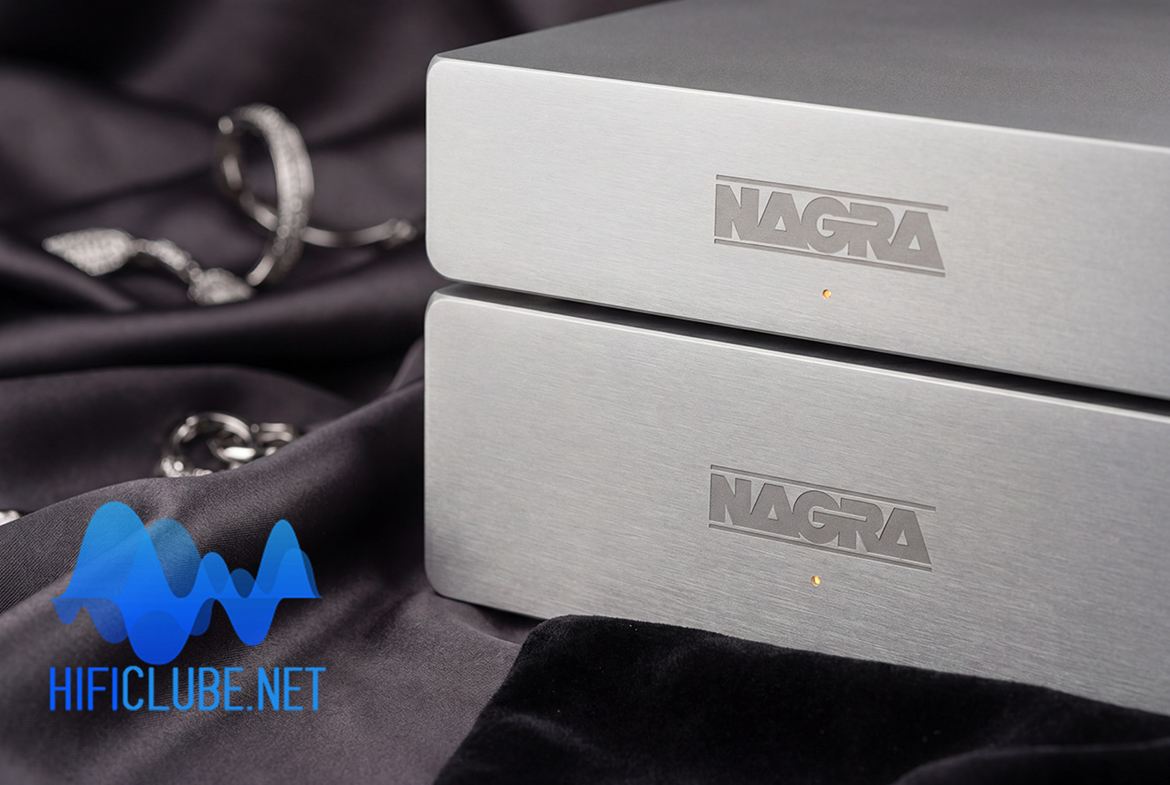
Some devices are small because they lack substance. Then there are devices that are small because they focus solely on the essentials without losing their soul: the Nagra Streamer and Player fall into this category. They bear the brand’s logo with the same pride as the top-of-the-range models.
In January, I had the pleasure of reviewing the Streamer for Hificlube in an article entitled Nagra Streamer – The Swiss Approach.
The design of the Compact Player (€6,500) draws on the Nagra Streamer but replaces its digital-only outputs with a D/A conversion stage and analogue outputs. At first glance, the Streamer and the Player are as alike as two peas in a pod. Both are CNC-machined from a solid block of aluminium and measure 18.5 × 16.6 × 4.1 cm.
Understated luxury
On both units, the front panel shows only the Nagra logo and a small amber LED. No display, no buttons. Nothing. It is an object of understated luxury, a jewellery box, or rather a safe, given its robustness.
Whilst the Streamer is essentially a network transport with digital outputs for an external DAC, the Player is a streamer/DAC that keeps the Performance Series minimalist philosophy: RJ45 Ethernet, a USB port for an external hard drive or memory, and RCA analogue outputs. There are no built-in Wi-Fi or digital outputs. At least an S/PDIF would have been useful.
The Player therefore connects to the network via cable only; control is via a mobile phone or tablet on the same home network. For some, this simplicity will be a virtue. For others, it will be a limitation, particularly for those who value future flexibility.
The Streamer is recommended for those who already own a Nagra DAC (via Nagra Link) or another of comparable quality and simply wish to add streaming functionality. The Player is more self-contained, as it only needs to be connected to an amplifier or a pair of active speakers via its analogue RCA outputs.
The Streamer is for the audiophile who likes to change their DAC every year, just as one might change their phone; the Player is for a die-hard Nagra enthusiast who lacks the financial means to buy the Classic DAC II, for example.
But note: the Player does not use the NADM module found in the Classic DAC II and the Reference DAC. Instead, Nagra has opted for an ESS chipset in a dual-DAC configuration to preserve the compact form factor and price point.
However, integration with existing services is extensive: Qobuz Connect, Tidal Connect, Spotify Connect, AirPlay 2, Roon Ready and Roon Tested, Audirvāna, JPLAY Certified and vTuner. Local playback can be achieved via USB or UPnP/DLNA.
Like the Streamer, the Player does not have a dedicated control app; instead, the mConnect Control app is recommended. It is free and can also be used to access local files and update the software.
The Nagra manual confirms that, via USB or the local network, the device plays high-resolution audio up to DSD256. I checked, and sure enough, it’s true...
What’s more, it played DSD512 files, albeit downsampled to DSD256, as well as PCM 384 kHz/24-bit files. But the LED colour remains unchanged, unlike DACs whose LED changes according to file format or resolution.
The Player does not have a fixed-volume mode. Volume control is handled via software (in the app or in Roon) and can therefore drive active speakers or a power amplifier directly.
However, Nagra itself states that the Player sounds best at maximum volume, as it was primarily designed to work with a separate pre-amplifier or an integrated amplifier. In this case, you should adjust the volume on the pre-amplifier, not the DAC.
I tested the Player with and without a pre-amplifier and didn’t notice much difference, partly because what is lost with digital volume control is offset by having fewer electronic components in the signal path.
There is also no immediately obvious difference between the Nagra Player and the Bluesound Node Icon, for example, which uses the same DAC chipset and is much cheaper. However, the difference is there. You just need to learn how to hear it.
An inner quest
This is almost an inner quest, because it depends more on you than on the equipment’s performance. Clearly, it’s not the same to wear a plastic Swatch on your wrist as it is to wear a Rolex, even though both tell the correct time. The pleasure of owning something exceptional also counts, and it counts a great deal!
The best way to understand the difference is to install the Compact PSU (€3,950) in the system.
Suddenly, everything becomes clearer, with more silence between the notes, a more spacious soundstage opens before your eyes, and you hear better vocal separation.
Now when you remove the PSU from the system, you have already learnt to hear the differences. They are still there with the Player by itself, albeit to a lesser degree.
The sound of the piano
Recently, Maria João Pires gave a very interesting interview to Máxima magazine in which she remarks:
‘Yes, the discovery of sound... I am much more connected to the sound than to the piano. The sound of the piano has always been a struggle: making the piano sing, giving it a real voice, not just the voice of a percussion instrument. I want it to tell stories, to speak to us. Nowadays, the piano is often played for sheer volume, but it can also imitate many instruments and sounds. That requires effort. Playing a note is not just playing a note: it is seeking the sound we want within its context. And that context, for me, must serve an idea.’
I am now listening to Mozart’s Piano Sonatas, performed by Maria João Pires, via the Player (primarily connected to the Compact PSU):
The piano sings; it has a voice, not merely the sound of percussion. It tells stories like Pires wants it to. It is not reduced to the mechanical evidence of the hammer striking the string, nor to the grandeur of the attack or the clarity of the transient. There is a more complete perception of the musical gesture: the note is born, takes shape, lingers for an instant in the air, and then fades away with a naturalness that preserves both the pianist's and the composer's intentions.
This ability of the Nagra Compact Player/PSU to give a 'voice’ to instruments spans all musical genres. The rhythmic energy and tonal signature remain, yet everything seems to integrate more effectively within the soundstage.
There is a subtle yet decisive difference between a DAC that clearly separates sounds (that timbral distinction I often speak of) and one that organises them musically within time and the surrounding space (temporal coherence). The former allows us to hear the details; the latter reveals the relationships between them. That's the Nagra Compact Player/PSU combo.
With the Nagra Compact Player/PSU one can no longer describe the bass as being merely solid or firm. It also gains an inner depth, while the bass lines breathe more freely and become clearer. The system seems to better restore the scale of events, allowing sounds to coexist within a more realistic musical context.
The silence between notes is also more convincing, and the instruments sound more focused without slipping into a mechanised, almost robotic presentation.
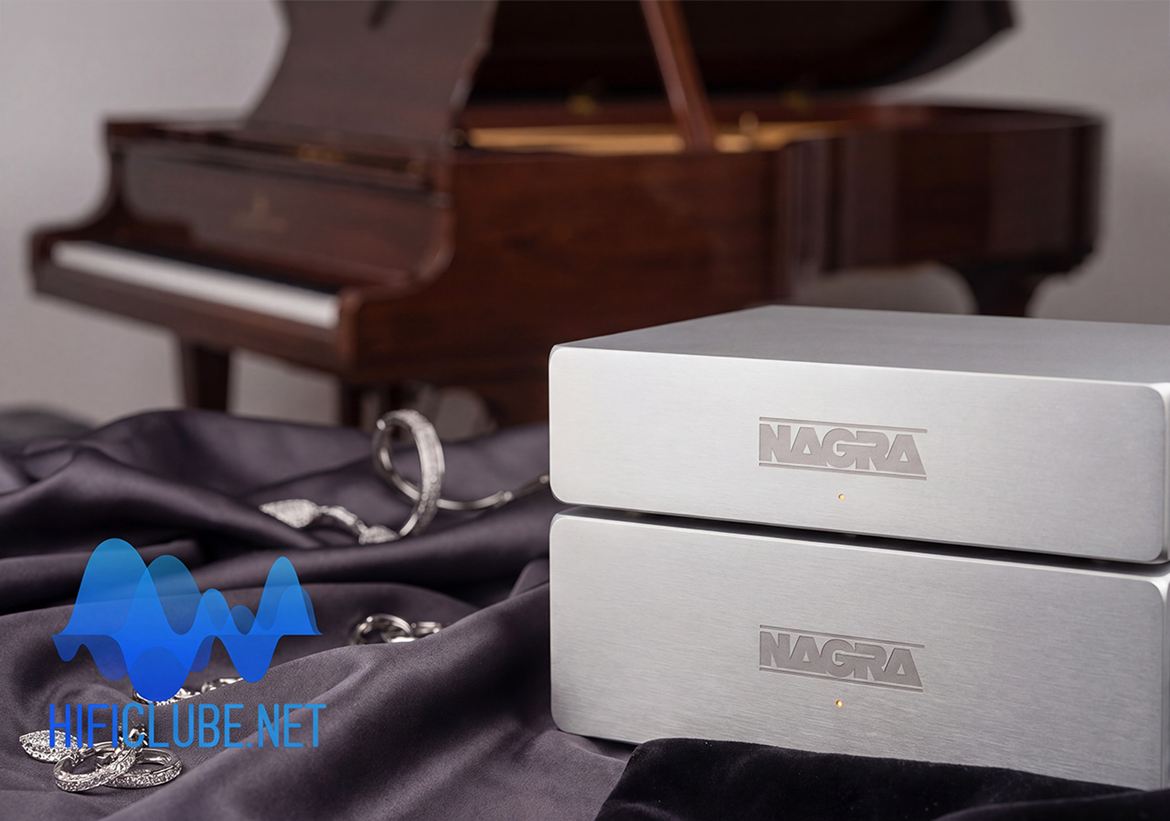
The piano ceases to be a mechanical instrument and becomes an extension of the pianist.
Small signs
Again, according to Maria João Pires: ‘Small signs — such as an accent — completely change in meaning from Haydn to Mozart or Beethoven.’
There are systems (and components) that place the stress on the right syllable. Others do not.
If you do not understand the relationship between the weight of a note and the pause that precedes it, you will never understand the difference between a touch that affirms and a touch that merely suggests.
The Nagra Compact Player is a device that demands a firm choice from those who know exactly what they want and who do not just follow trends.
Anyone looking for a streamer/DAC with multiple digital and balanced inputs and outputs, Wi-Fi, Bluetooth and a touchscreen will find far more comprehensive and cheaper alternatives on the market.
Anyone looking for a compact, discreet digital source, solidly built and easy to use, with Nagra’s sonic pedigree, simply must go and listen to the Player, with and without the Compact PSU and the VSF platform, at your local dealer. Bring your chequebook, just in case...
Note: I know some readers will feel this isn’t a review in line with audiophile orthodoxy because I don’t mention the associated equipment, including the cables – a source of endless controversy – nor do I provide a list of the discs I listened to. A true heresy!
But just as with appreciating art, I sometimes prefer to look at the artwork and let myself be guided by my emotions. Not least because your system will invariably be different from mine, as will the music you like to listen to, not to mention the room. Therefore, all you need to do now is take my humble opinions here expressed and incorporate them into your reality in the light of your own feelings.
Nagra Compact Player: €6.500
Nagra Compact PSU: €3.950
Nagra Compact VSF (base): €1.495